

Project Overview: Increasing Resilience in Underserved Communities in Türkiye

Featured photo: A child protection and gender based violence (GBV) awareness raising session with women in Kayseri. Photo by RET.
Article by Ali Selim Kara, Communications Officer for LEAP
As part of our commitment to accessibility, this article is also available in Turkish.
In the last decade, over four million refugees have entered Türkiye, making it the country with the largest refugee population in the world. The devastating earthquakes of 2023 compounded this issue: the quakes reached a magnitude of 7.7 and 7.8, hitting Kahramanmaraş and the surrounding provinces, an area that was hosting half of all the refugees in Türkiye. Across the country, over 50,000 people were killed, and three million remain internally displaced. The refugee communities also lost their families, friends, and social networks, and they have once again been displaced.
Considering the low number of refugees who have formal employment, and that many of them lack social channels, it will be much harder for these vulnerable groups to acquire employment. Therefore, it will be much harder for these vulnerable groups to find new work. Furthermore, the earthquakes resulted in an increase in social unrest among the host community and refugee communities.
To combat these issues and assist these vulnerable populations, RET is implementing the “An Integrated Approach to Increase Resilience in Underserved Communities” program in Çorum, Aksaray, Kayseri, and Samsun. Besides hosting a high number of refugees, these cities are also among the cities that received new waves of migration after the earthquake.
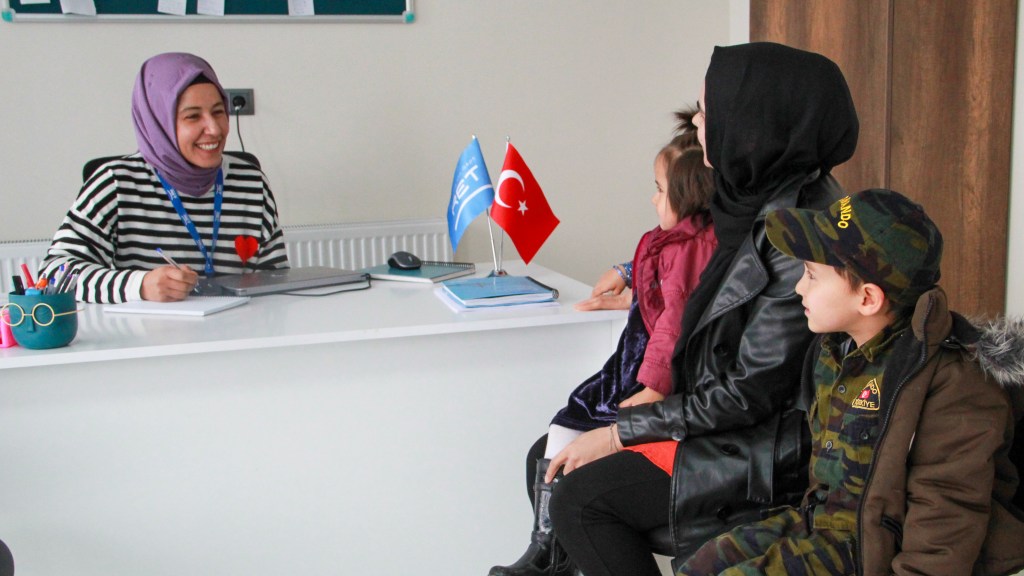
Photo by RET.
They are also critical centers because:
- They are satellite cities that host large numbers of non-Syrian refugees under international protection along with Syrians under temporary protection, yet they offer limited protection and livelihood capacities.
- Humanitarian response, in general, is focused on Syrians under temporary protection as target groups, and there is a need for support to increase protection and livelihood opportunities for refugees under international protection residing in these provinces.
- These provinces have homogenous and conservative settings where refugees struggle with integrating, and women are, in particular, at risk of gender-based violence (GBV). In these settings, social tensions frequently arise.
In order to increase the resilience of vulnerable, underserved refugee communities and ensure social cohesion among refugees and host community members, the “An Integrated Approach to Increase Resilience in Underserved Communities” program aims to:
- Increase access to protection and improve psychosocial well-being through community centers.
- Strengthen protection mechanisms through capacity-building trainings.
- Foster and link local human resources with the labor market (livelihoods).
Community-Based Protection Activities
Community centers will be established in vulnerable neighborhoods with high refugee populations and will act as a shared communal resource and gathering space. The project will take a holistic approach through various activities.
Awareness-Raising and Information Dissemination Sessions
Through awareness-raising and information dissemination sessions, RET focuses on rights, entitlements, and opportunities to build individuals’ knowledge and capacity to identify, demand, and effectively access services, including legal aid, registration, application to social assistance, school registration, access to health services, disability rights, disability-related challenges in the workplace, local business opportunities, free/affordable capacity-building services to boost employability.
Specialized Psychosocial Support
Specialized psychosocial support activities aim to strengthen psychological well-being and resilience and increase the ability of participants to apply positive coping mechanisms.
Case Management and Referral
Through case management and referral activities, RET applies a rapid assessment to the beneficiaries, identifies persons with protection concerns, and provides services, including the provision of psychological first aid, internal referrals to counseling, or external referrals to other service providers, as needed.
Turkish Language Courses
One of the keys to social cohesion is speaking the same language, which increases the capacity of empathy of both sides and helps ease the integration of refugees in the labor market and social life. Thus, RET provides Turkish language courses designed for refugees to support language acquisition. Participants who complete the Turkish Language Courses offered through Public Education Centers are awarded a certificate. Additionally, language courses provided by TÖMER as part of livelihood empowerment activities are accredited by the European Language Portfolio.
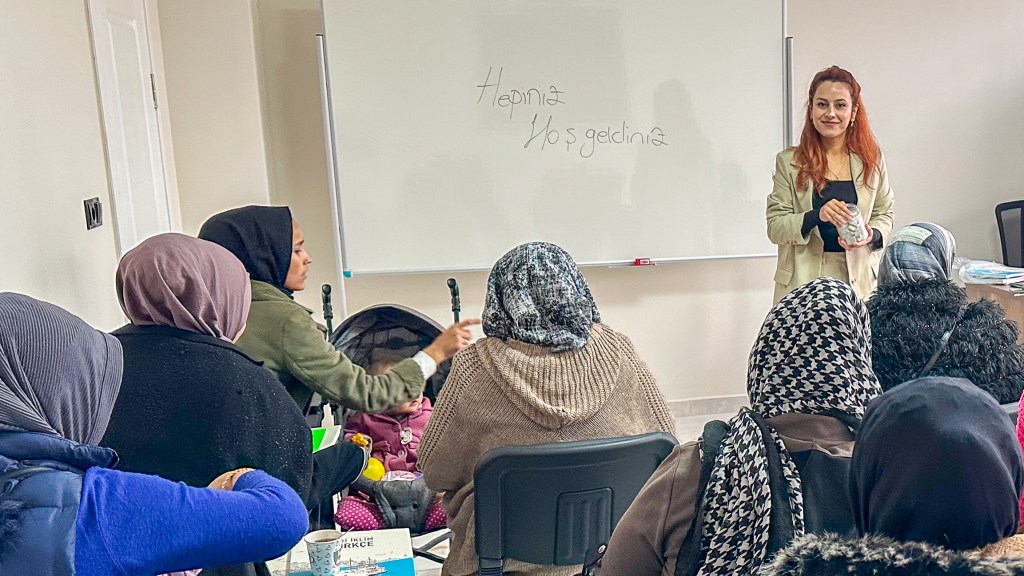
A Turkish language training course in progress, in Aksaray. Photo by RET.
Recreational Workshops
Women and children -specifically impacted by the earthquake- from host and refugee communities will participate in recreational psychosocial support workshops such as soap making, wood printing, etc., to increase feelings of self-fulfillment.
Capacity Strengthening Activities
The program proposes to strengthen protection mechanisms through tailored, lasting, and holistic capacity-building trainings. The aim of these trainings is to mainstream (i) rights-based humanitarian assistance, (ii) GBV (Gender-based Violence), and (iii) social cohesion. The trainings target service providers that include national and local level public institutions such as municipalities, provincial directorates of migration management, community-based organizations, etc.
- RET provides workshops and capacity-building trainings on protection principles and humanitarian standards to mainstream rights-based humanitarian assistance.
- Capacity-building trainings on mainstreaming GBV and social cohesion to the staff of municipalities, public authorities, and local NGOs aim to sensitize and encourage them to mainstream GBV and social cohesion interventions in their activities and mobilize their resources for the protection of women and girls.
- RET provides a one-day capacity-building training on communication with trauma survivors and psychological first aid to the staff of municipalities, public authorities, and local NGOs.
Livelihoods Activities
The project intends to develop a sustainable solution to socioeconomic problems by supporting existing structures and promoting local human resources. To do so, a profiling study will be conducted by business support officers as the initial step of this activity. Based on the assessment of each participant’s profile, RET will provide counseling and orientation and refer individuals to vocational, life skills, and entrepreneurship trainings as well as job opportunities. Counseling will include individualized awareness raising on adaptation to professional life and existing opportunities such as TVETs, livelihood projects of other actors, cooperatives, micro-credit opportunities, etc.
This program’s implementation began in September 2023 and will continue through August 2026. It has been funded by the U.S. Department of State’s Bureau for Population, Refugees and Migration (BPRM) and implemented by RET in Türkiye.
To help us continue this critical work in Türkiye, consider making a recurring donation to RET today.
You must be logged in to post a comment.