

LAC-WDN Coalition Positions Human Mobility and Disasters Agenda at Regional Forum with RET Participation

Photo by Paula Uribe, © RET International
Article by Paula Uribe, Regional Technical Manager of RET in Latin America and the Caribbean
PANAMA CITY, PANAMA – Within the framework of the Regional Forum on the Central American Policy for Integrated Disaster Risk Management (PCGIR), the thematic event on migration and displacement in disaster contexts was held, a space for technical and political dialogue that addressed the differentiated impacts of climate and environmental risks on the dynamics of human mobility in Latin America and the Caribbean.
In this space, Leonarda De Gracia, RET Program Coordinator in Panama, participated on behalf of the Coalition of Civil Society Organizations (CSOs) for the Defense of the Rights of Refugee, Migrants and Displaced Populations in Latin America and the Caribbean (LAC-WDN Coalition), a strategic alliance of civil society organizations, national, regional and international standards with regional coverage in Latin America and the Caribbean that work with refugee, migrant and displaced populations within the framework of international and regional principles and standards of Human Rights, International Refugee Law and International Humanitarian Law).
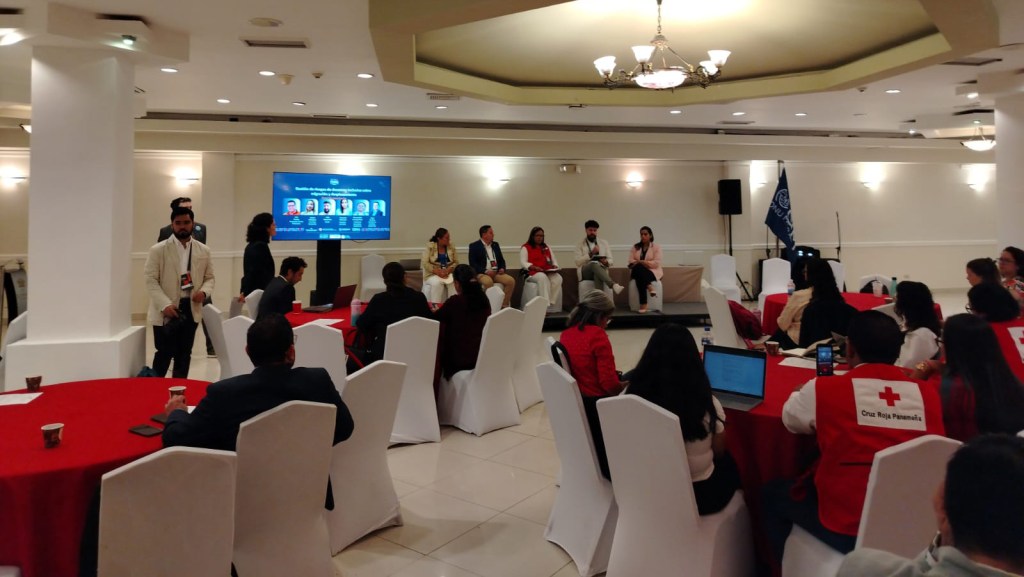
Photo by Paula Uribe, © RET International
During the intervention, it was highlighted that disasters not only represent an additional threat to people on the move, but also deepen pre-existing vulnerabilities, especially in contexts where many families live in informal settlements or territories highly exposed to floods, landslides and extreme events. These conditions increase the risk of loss of livelihoods, limit access to basic services, and make it difficult to receive humanitarian assistance or protection.
It was also underlined that the impacts of disasters also significantly affect returnees and host communities, generating cycles of recurrent displacement, pressure on local service systems and greater challenges for social cohesion and territorial development. Faced with this scenario, the need to move towards durable solutions based on territorial resilience, multilevel governance and triple nexus approaches between humanitarian action, development and peace was emphasized.
The LAC-WDN Coalition reiterated that understanding the link between disasters and mobility implies recognizing that the climate crisis is also a human rights crisis, which amplifies structural inequalities and affects women, girls, boys, older people, people with disabilities, indigenous peoples, and Afro-descendant communities in an intersectional way.
In this regard, a call was made to strengthen coordination between risk management systems, humanitarian actors and governments to ensure that processes such as planned relocations for environmental reasons become sustainable solutions that reduce vulnerabilities and prevent further displacement.
RET’s participation in this space reaffirms its commitment to promoting anticipatory and people-centered approaches, promoting public policies and territorial practices that integrate human mobility in disaster risk reduction and climate adaptation. In a regional context marked by the convergence of climate, social and mobility crises, moving towards coordinated and rights-based responses is key to protecting lives and strengthening the resilience of communities.
To support our work, make a donation to RET today.
You must be logged in to post a comment.