

Over 7.7 million Venezuelans have left their home since 2014, making this exodus the largest displacement crisis in Latin America. The majority (6.5 million) have taken refuge in other countries in the region. Ecuador hosts the fifth largest number (over 444,000) of Venezuelan refugees and migrants in the region after Colombia, Peru, Brazil, and Chile.
Despite efforts by the Government, Venezuelan refugee children and their families continue to face significant barriers to accessing essential services, including education. This crisis is further compounded by the lingering impacts of the COVID-19 pandemic, the economic, political, and security upheavals. Within this context, access to quality education remains a key challenge for refugee and migrants as well as host community children.
The second MYRP in Ecuador will be implemented by RET International (grantee), leading a consortium of partners also including Plan International (serving as the Gender Lead Organization, GLO), ChildFund and the Ibero-American Institute of Natural and Cultural Heritage of the Andrés Bello Convention Organization (IPANC-CAB), in eight cantons (Esmeraldas, Guayaquil, Lago Agrio, Manta, Milagro, Quevedo, Quito, Santo Domingo). It aims to reach 42,700 refugee, migrant and host community girls and boys at pre-primary, primary and secondary level, over three years, including 52 percent refugee and migrant children, 60 per cent girls and 10 percent children with disabilities. The programme aims to achieve the following outcomes:
- Outcome A. Access to safe, equitable, and gender-transformative education opportunities for refugee, migrant and host community children.
- Outcome B. Retention of refugee, migrant and host community children in the education system and in safe, gender-transformative and inclusive learning environments.
- Outcome C. Improved learning outcomes and skills of refugee, migrant and refugee children through holistic, inclusive and gender-transformative strategies.
- Over 40,000 children and adolescents will be reached through formal education.
- 2,700 children and adolescents will be supported with non-formal education.
- Over 15,000 children and adolescents will be enrolled in ECW-supported education programmes.
- Over 10,000 adolescents will receive mental health and psychosocial support.
- Over 7,500 teachers will be trained on inclusive education.
- Over 8,000 parents and caregivers will receive effective mechanisms for preventing and responding to violence (including GBV) in an outside the school environment.
- Over 40,000 children and adolescents will be reached through formal education.
- 2,700 children and adolescents will be supported with non-formal education.
- Over 15,000 children and adolescents will be enrolled in ECW-supported education programmes.
- Over 10,000 adolescents will receive mental health and psychosocial support.
- Over 7,500 teachers will be trained on inclusive education.
- Over 8,000 parents and caregivers will receive effective mechanisms for preventing and responding to violence (including GBV) in an outside the school environment.

Children on the Move: An Education Space to Keep Moving Forward in Ecuador
When children and adolescents move across countries, they face many changes: family dynamics, familiar environments, and even how to solve a math problem or the words used to ask for a pen. But something travels with them—their dreams.

RET en español: La niñez en migración: un espacio educativo para no quedarse atrás en Ecuador
Cuando la niñez y la adolescencia se desplazan a otro país, afrontan varios cambios. La familia, los espacios conocidos, la forma de resolver un problema de matemática e incluso los términos para pedir un esfero. Pero hay algo que se mueve con ellas y ellos: sus sueños.
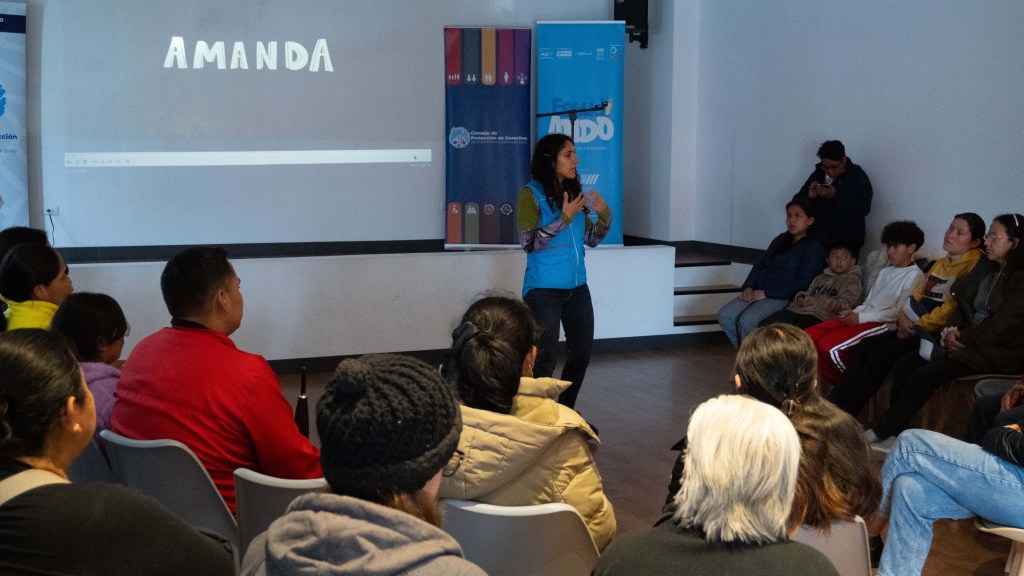
In Ecuador, EstudiANDO Promotes STEM Careers on International Women’s Day
The EstudiANDO Program promoted educational and community spaces to reflect on gender stereotypes and encourage the participation of girls and adolescents in science, technology, engineering, and mathematics.