

Until Everyone Is Safe: Stories of Resilience from More Than a Quarter Century of Standing with Refugees

Photo © RET International
Article by RET International HQ
World Refugee Day – June 20, 2026
GENEVA, SWITZERLAND – This year, UNHCR’s theme for World Refugee Day is Until Everyone Is Safe. It is a simple and demanding statement; it asks us to hold in mind not just the people we have reached, but the ones we haven’t yet. It highlights not just the progress made, but the distance still to go.
At RET International, we have been working toward that goal for more than a quarter century. In that time, we have seen what is possible when displaced people are given the right support at the right moment. We have also learned something important: Safety is never just the absence of danger. It is the presence of education, dignity, livelihoods, and hope. It is the knowledge that you belong somewhere, and that your future is worth building.
These are the stories that remind us why we do this work — and why until everyone is safe is not just a slogan, but a commitment.
Türkiye: “Getting ready and leaving the house in the morning, there is freedom inside it.”
Maha is 58 years old. She first arrived in Türkiye from Syria in 2015, then returned home when she couldn’t bear to be without her family. Over time, living conditions deteriorated. Daily life became harder. Her children eventually scattered to different countries. She came back to Türkiye, and this time, she decided to stay.
When she heard about the Leap Natural workshops in Mardin, she wasn’t sure what to expect. The RET-supported women’s cooperative produces soap, woodblock-printed textiles, natural dyes. But Maha had a realization: “It was a door for me,” she says. “I wanted to try.”
What she found was more than a workshop. It was a cohort of women, both Syrian and Turkish, producing together, laughing together. “It felt as though we were not just working,” Maha says. “We were healing.”
Today she wakes up early every morning and goes to work. She makes natural products sold under the Leap Natural brand. She has a place to be; she has colleagues; and most importantly, she has purpose.
“A person who produces feels strong. I am no longer just someone carrying her past. I am a woman who produces and stands on her own feet.”
Maha’s story carries a significance that extends beyond her own life. As the Syrian civil war gave way to a new chapter – and as refugees across Türkiye began making the choice to return home – the skills, confidence, and networks they built during their years of displacement are traveling with them. They are not returning empty-handed. They are returning ready to contribute to the reconstruction of their country and their communities. It is the outcome that guides everything we do: not dependency, but dignified, empowered return.


Photos © RET International
Want to support our work across the world?
Peru: “To educate is to love”
Not everyone who is displaced is a refugee. The distinction matters legally, but the human reality is often the same: People forced to leave everything behind, arriving somewhere new, carrying skills the world hasn’t recognized yet.
In Lima, Peru, two Venezuelan teachers named Andrea Navea and Rossy Bayona know that reality well. They are migrants (not refugees under international law), but they arrived in Peru as part of the massive displacement from Venezuela that has seen more than 1.66 million people seek a new beginning in the country. Peru now hosts the second-largest Venezuelan population in the world.
Andrea arrived eight years ago: “I arrived in Peru and I have always worked as a teacher in schools,” she says. “I love the work of education.” Rossy sees her classroom as something more than a place of learning: “Educating a person is going beyond imparting knowledge. It is trying to make that child feel safe, feel loved, feel cared for, listened to, that their opinion is valid.”
Through Diverticlases, part of Aprender Sin Barreras (Learning Without Barriers), a Multi-Year Resilience Program funded by Education Cannot Wait and implemented in a consortium led by RET, Andrea and Rossy are doing exactly that.
They run tutoring sessions, provide socio-emotional support, and help children navigate a new educational system. They don’t just teach; they build community. And in doing so, they have turned their own experience of displacement into something that opens doors for others.
Their work is a reminder that displacement, when met with the right support, can become contribution. That migrants and refugees are not a burden on the communities that receive them; they are part of what those communities become.

Photo © RET International
Click here to read the full story from Peru (English).
Nigeria: “In workshops that once stood unused, something new is being made.”
Along the Niger–Nigeria border, in the Local Government Areas of Katsina State, the workshops had been there for years. They were underused, their infrastructure deteriorating, their tools outdated. What was missing wasn’t will. It was investment, and someone to believe the work was worth doing.
RET Germany and its local partner CCDRN decided to try. Funded by the German government’s BMZ, the project targets 9,000 vulnerable participants across this border region (60% of them women, 45% youth) in communities where displacement, unemployment, and climate shocks have compounded across generations.
The first thing the project did was put money directly into people’s hands: Unconditional cash transfers to 520 participants before a single vocational course had begun. The instruction was simple: use it as you see fit. Seventy-eight percent chose to invest in a small business. They were not thinking about survival. They were thinking about the future.
Since then, the workshops have come alive. Cosmetology trainees are producing soaps and beauty products for local markets. Carpentry students are selling sofas and wardrobes and using the revenue to maintain their own training centers. Women in tailoring and solar installation have begun securing paying clients. The tools are new; the buildings have been repaired; the curricula have been updated. But what has really changed is something harder to measure: the sense, in communities that have absorbed crisis after crisis, that building something here is possible.
The Sahel is one of the most fragile regions on earth. Armed groups, political instability, climate shocks, and hunger have all tightened their grip in recent years. Until everyone is safe in this part of the world means not only protection from immediate danger, but the kind of deep economic and community resilience that makes people less vulnerable to the next crisis — and the one after that.
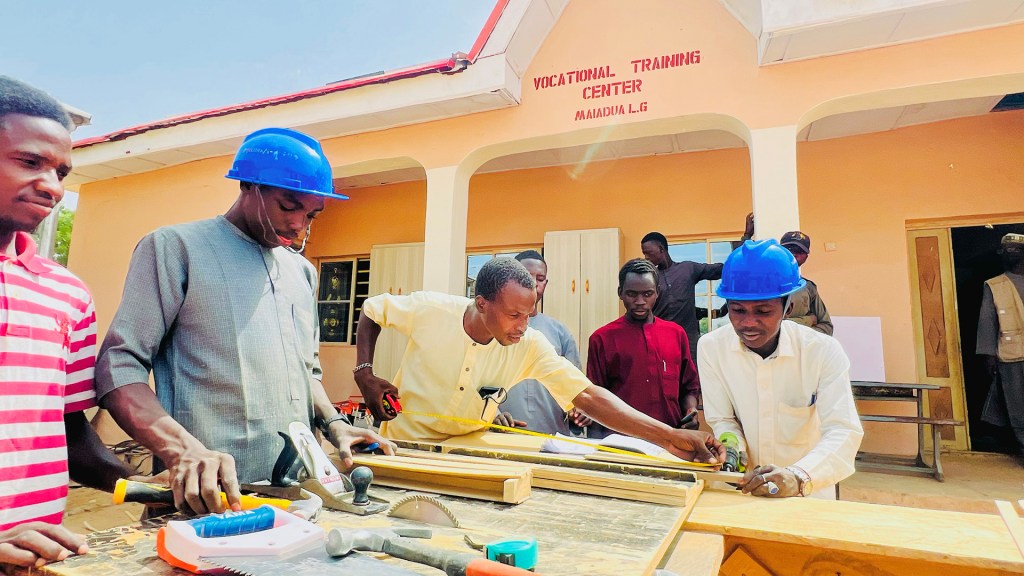
Photo © RET Germany
Read more about RET Germany’s work in Nigeria.
The Need Hasn’t Changed. But the World Has
Since our founding in 2000, RET has worked in more than 35 countries, implementing over 460 projects and reaching more than 2.5 million people. In 2024 alone, we reached 250,000 program participants across 15 countries. These numbers matter. But they don’t capture the full picture of what we face.
The need to protect and support displaced communities has not diminished. If anything, the forces driving displacement are multiplying. Climate shocks are intensifying, pushing people from land they have farmed for generations. Political instability and armed conflict continue to displace millions across the Sahel, the Middle East, and Latin America. Economic collapse creates waves of migration that blur the lines between refugee and migrant but not the urgency of the response. More than 120 million people are now forcibly displaced worldwide – the highest number ever recorded.
At the same time, we have more tools than ever before. AI-assisted monitoring is helping us measure impact more precisely and adapt programs in real time. Remote and hybrid learning models – developed and tested through years of work in fragile contexts – are extending the reach of education to communities that no contact could previously access. Digital platforms are connecting displaced people with livelihoods, services, and each other.
These advances don’t replace human presence, community trust, or the deep local knowledge that RET’s teams bring. But they extend what’s possible. They help us reach further and respond faster, and they are part of how we plan to serve the next generation of displaced communities.
What they cannot replace is your support.
The gap between what is needed and what is funded is real and growing. The communities at the center of these stories – Maha, Andrea, Rossy, the communities in Niger and Nigeria, and millions like them – are counting on the continued commitment of people who believe, as we do, that until everyone is safe is not just a theme for one day. It is a responsibility for every day.
Help us build something extraordinary. Stand with us, as we have stood with these communities for more than a quarter century, and together, we will keep bridging the gaps.
To support our critical work with refugees, migrants, and displaced communities around the world, donate to RET today.
You must be logged in to post a comment.